Group of medium sized dog breeds including Beagle, Bulldog, Whippet, Poodle, Australian Shepherd, and Cocker Spaniel sitting together on green grass in a park
Author: Lucas Fairmont;Source: alwaysonsalepetsupplies.com
The American Kennel Club classifies medium sized dogs as breeds typically weighing between 30 and 60 pounds at healthy adult weight. Height usually ranges from 18 to 24 inches at the shoulder, though proportions vary—a stocky Bulldog and a lean Whippet might share the same weight class while looking completely different.
These parameters aren't arbitrary. A 35-pound dog requires roughly half the food of a 90-pound breed, saving $400-600 annually. Veterinary medication dosing often jumps at the 60-pound threshold, affecting heartworm prevention and flea treatment costs. Medium dogs fit comfortably in standard sedan back seats and meet most apartment weight restrictions, which commonly cap at 50-60 pounds.
Breed standards matter more than individual variation when planning long-term. A "small" Labrador Retriever at 50 pounds is still genetically programmed for the exercise needs and joint considerations of the breed, not the reduced requirements of a true 50-pound breed like a Cocker Spaniel.
How Medium Dogs Compare to Small and Large Breeds
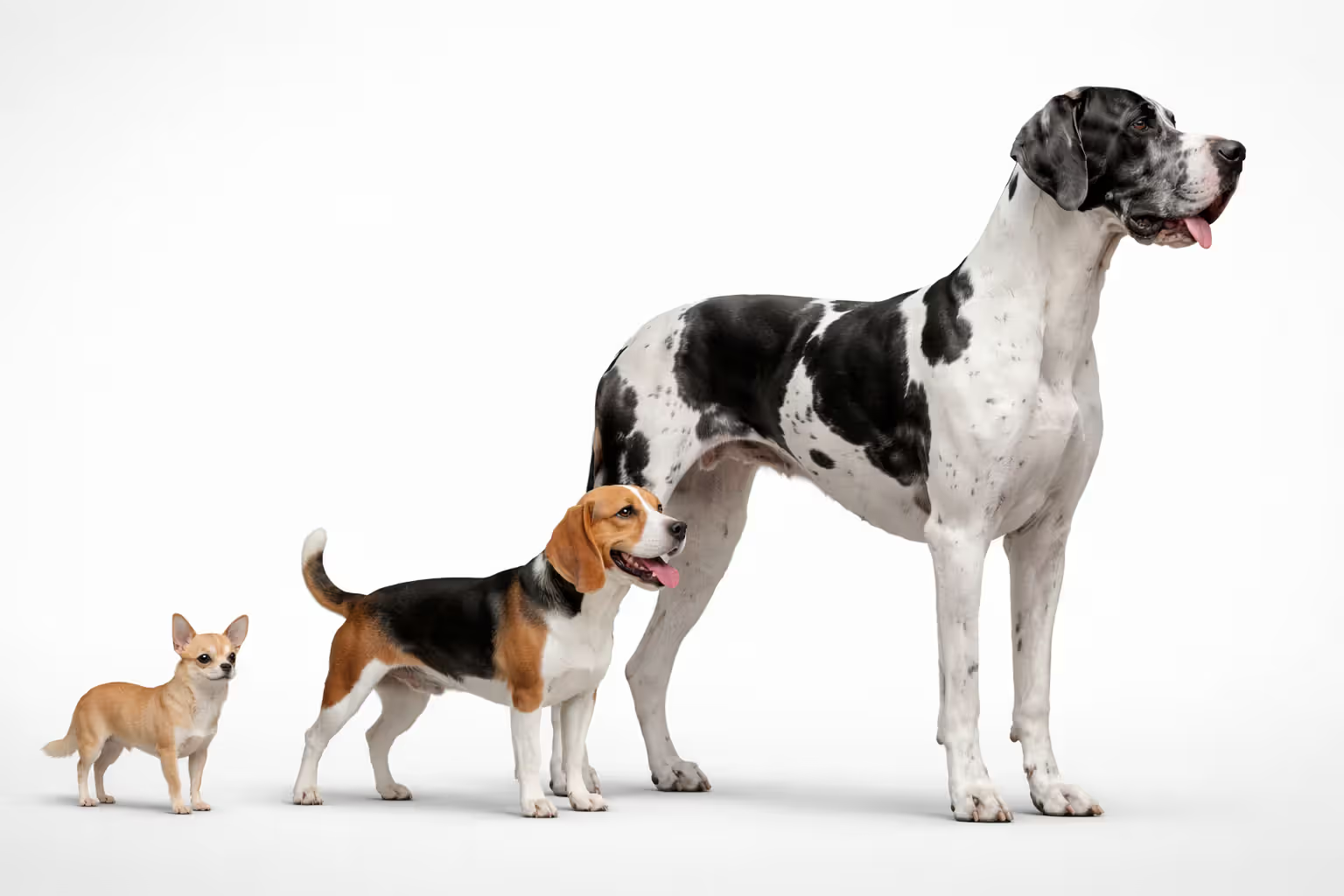
Medium dogs avoid the fragility issues common in toy breeds—a toddler's accidental step won't cause injury. They're sturdy enough for hiking partners but won't knock over elderly relatives during greetings like an enthusiastic Great Dane might.
Large breeds cost 40-60% more to feed and face higher rates of hip dysplasia, bloat, and shortened lifespans. Small breeds live longer but often struggle with dental disease and can develop "small dog syndrome" behavioral issues when owners skip training. Medium breeds typically live 10-13 years, splitting the difference between small breeds (12-16 years) and giant breeds (7-10 years).
Boarding and grooming services frequently charge by weight brackets. Medium dogs usually land in the middle pricing tier, while anything over 60 pounds triggers premium rates.
Author: Lucas Fairmont;
Source: alwaysonsalepetsupplies.com
Best Medium Dog Breeds for Families with Children
Family-friendly medium dogs need more than tolerance—they require patience with ear-pulling, resilience during chaotic play, and energy levels matching kids without overwhelming them.
Beagles (20-30 lbs) bring pack-oriented temperaments that translate to family bonding. Their hunting background means they follow scent trails obsessively, so fenced yards are non-negotiable. Expect howling when lonely; apartments with shared walls can be problematic.
Brittany Spaniels (30-40 lbs) were bred to work alongside hunters all day, creating dogs that genuinely enjoy children's endless energy. They're sensitive to harsh corrections—perfect for teaching kids gentle training methods. Weekly brushing handles their moderate shedding.
English Springer Spaniels (40-50 lbs) show remarkable patience with children's unpredictable movements. Split into show and field lines; field-bred dogs need 90+ minutes of daily exercise, while show lines manage with 60 minutes. Both types require professional grooming every 6-8 weeks.
Cocker Spaniels (25-30 lbs) adapt their energy to household activity levels better than most breeds. Ear infections plague dogs with those long, floppy ears—budget for cleaning solution and regular vet checks. American and English Cockers differ significantly; American types have shorter muzzles and calmer dispositions.
Standard Poodles (45-60 lbs) rank second in canine intelligence, making training straightforward even for first-time owners. Their hypoallergenic coats require professional grooming every 6 weeks at $60-90 per session. They bond intensely with families but can develop separation anxiety without gradual alone-time training.
Collies (50-65 lbs, upper medium range) possess legendary gentleness with children, though their herding instinct means they'll circle and nudge kids during play. Rough Collies need extensive brushing; Smooth Collies shed heavily twice yearly but otherwise need minimal grooming.
Wheaten Terriers (35-40 lbs) offer hypoallergenic coats and enthusiastic, bouncy personalities. They mature slowly—expect puppy behavior until age three. Daily brushing prevents matting in their soft, silky fur.
Breed Name
Weight Range
Energy Level
Kid-Friendliness (1-5)
Grooming Needs
Beagle
20-30 lbs
High
5
Low (weekly brushing)
Brittany Spaniel
30-40 lbs
Very High
5
Moderate (weekly brushing)
English Springer Spaniel
40-50 lbs
High
5
High (professional every 6-8 weeks)
Cocker Spaniel
25-30 lbs
Moderate
5
High (professional every 6 weeks)
Standard Poodle
45-60 lbs
Moderate-High
5
Very High (professional every 6 weeks)
Collie (Rough)
50-65 lbs
Moderate
5
High (daily brushing)
Wheaten Terrier
35-40 lbs
High
4
High (daily brushing)
Top Medium Dogs for Apartments and Small Homes
Apartment-friendly medium dogs succeed through lower barking tendencies, moderate exercise needs, and adaptability to indoor routines. Size alone doesn't determine apartment suitability—a quiet 50-pound dog works better than a yappy 15-pound terrier.
Basset Hounds (40-65 lbs) embody low-energy apartment living. Two 20-minute walks daily satisfy their exercise needs. Drool and a distinctive hound odor require acceptance. Their long backs need ramp assistance for furniture and cars to prevent disc injuries.
Bulldogs (40-50 lbs) thrive in apartments with minimal exercise requirements—15-20 minutes twice daily prevents overheating. Breathing difficulties from their flat faces mean air conditioning isn't optional in warm climates. Budget $500-1,000 annually for wrinkle-fold cleaning supplies and potential skin infection treatments.
Cavalier King Charles Spaniels (13-18 lbs, small-medium) adapt to any living situation. Heart disease affects 50% by age five; purchase only from breeders who cardiac-test breeding dogs annually. Their silence and affectionate nature suit apartments perfectly.
French Bulldogs (16-28 lbs) rarely bark without cause and need minimal exercise. Airline travel restrictions apply due to breathing issues—many airlines ban flat-faced breeds after in-flight deaths. Expect $2,000-4,000 in potential breathing-related surgeries over their lifetime.
Whippets (25-40 lbs) surprise owners with their couch-potato indoor behavior despite being sighthounds. They need one good 30-minute run daily, then sleep 18 hours. Near-zero body fat means they feel cold; sweaters aren't optional below 50°F.
Keeshonds (35-45 lbs) were bred as barge dogs in tight quarters, creating naturally quiet, adaptable companions. Their thick double coat sheds heavily twice yearly—professional de-shedding treatments ($50-80) every six months manage the volume. They bark to alert but stop when acknowledged.
Tibetan Terriers (20-30 lbs) historically lived in monasteries, developing calm indoor temperaments. Despite "terrier" in their name, they're not true terriers and lack that group's high prey drive and barking tendencies. Professional grooming every 6-8 weeks maintains their corded or fluffy coat options.
The world would be a nicer place if everyone had the ability to love as unconditionally as a dog
— M.K. Clinton
High-Energy Medium Breeds for Active Owners and Outdoor Lifestyles
Active medium dogs need 90+ minutes of vigorous exercise daily—not walks, but running, swimming, or training activities that create mental and physical exhaustion. Skipping exercise leads to destructive behavior, excessive barking, and anxiety issues.
Border Collies (30-55 lbs) represent the extreme end of energy and intelligence. They excel at agility, herding trials, and disc dog competitions. Without 2-3 hours of daily mental and physical work, they'll create their own jobs—usually involving shredded furniture or escaped-artist fence clearing. First-time owners typically underestimate their intensity.
Author: Lucas Fairmont;
Source: alwaysonsalepetsupplies.com
Australian Shepherds (40-65 lbs) bond intensely with their person, making them outstanding hiking and running partners. They'll herd children, pets, and even vacuum cleaners. Genetic testing for MDR1 mutation (drug sensitivity) is mandatory before any anesthesia or medication.
Brittany Spaniels (30-40 lbs) were mentioned in family dogs but truly shine with active owners. They'll run 10+ miles without tiring and swim for hours. Hunting instinct remains strong; off-leash reliability requires extensive training.
Vizslas (45-65 lbs) earned the nickname "Velcro dogs" for following owners everywhere. They need running, not walking—think 5+ mile runs or 90-minute fetch sessions. Separation anxiety develops quickly without gradual independence training.
Portuguese Water Dogs (35-60 lbs) were bred to herd fish and retrieve fishing gear, creating tireless swimmers. Webbed feet make them exceptional dock diving competitors. Their hypoallergenic coats require professional grooming every 6-8 weeks.
English Springer Spaniels (Field Lines) (40-50 lbs) differ dramatically from show-bred Springers. Field dogs need intense daily exercise and excel at hunt tests, agility, and flyball. Show-bred Springers need 40% less exercise—verify lineage before purchasing.
Dalmatians (45-70 lbs) were bred to run alongside carriages for 20+ miles daily. That endurance remains. They're prone to deafness (30% are deaf in one or both ears) and urinary stones requiring special diets. Their short coat sheds constantly—year-round, heavy shedding that embeds in fabric.
Setters (English, Irish, Gordon) (45-70 lbs) bring elegance and endurance. Irish Setters are the most energetic, Gordon Setters the calmest, and English Setters fall between. All need 90+ minutes daily and excel at pointing breed field trials.
Grooming, Health Costs, and Lifespan: What to Budget for Medium Breeds
Annual costs for medium sized dogs range from $1,200 to $3,500 depending on breed-specific needs. Food costs $400-800 yearly for quality kibble. Routine veterinary care (annual exam, vaccines, heartworm/flea prevention) runs $400-600.
Money can buy you a fine dog, but only love can make him wag his tail
— Kinky Friedman
Grooming creates the widest cost variation. Wash-and-wear breeds like Beagles need occasional baths ($30-50 each or DIY) and nail trims ($15-25 every 6-8 weeks). Professional grooming breeds like Poodles, Cocker Spaniels, and Wheaten Terriers require appointments every 6-8 weeks at $60-100 per session, totaling $480-800 annually.
Health issues cluster by breed type. Flat-faced breeds (Bulldogs, French Bulldogs) face breathing surgeries ($2,000-5,000). Deep-chested breeds (Setters, Dalmatians) risk bloat, a life-threatening emergency requiring $3,000-7,000 in surgery. Long-backed breeds (Basset Hounds) develop disc disease needing $3,000-8,000 in treatment.
Pet insurance for medium breeds costs $30-60 monthly ($360-720 annually). Policies typically cover 70-90% of expenses after deductibles. Pre-existing conditions aren't covered, making puppy enrollment optimal.
Lifespan averages favor leaner, longer-nosed breeds. Beagles, Poodles, and Whippets commonly reach 14-15 years. Bulldogs and Basset Hounds average 8-12 years due to structural health challenges.
How to Choose the Right Medium Dog Breed for Your Home
Match breeds to your actual schedule, not aspirations. A Border Collie won't thrive because you want to become more active—they need owners who already run 10 miles weekly.
Time assessment: Calculate daily availability honestly. Subtract work hours, commute, and commitments. Puppies need bathroom breaks every 2-3 hours; adult dogs manage 6-8 hours alone maximum. High-energy breeds need 90+ minutes of exercise plus training time. Lower-energy breeds function with 45-60 minutes.
Experience level: First-time owners succeed with eager-to-please breeds like Brittanys, Cocker Spaniels, and Poodles. Avoid independent thinkers (Basset Hounds, Beagles) and intense working breeds (Border Collies, Cattle Dogs) without prior training experience.
Living space: Square footage matters less than access to exercise areas. A house without a yard requires multiple daily outings. Apartments work for any breed if you'll walk 3-4 times daily and provide adequate exercise. Noise tolerance of neighbors dictates barking-prone breeds.
Author: Lucas Fairmont;
Source: alwaysonsalepetsupplies.com
Climate considerations: Double-coated breeds (Collies, Keeshonds) struggle in heat and humidity—air conditioning is mandatory. Short-coated breeds (Whippets, Vizslas) need protection below 50°F. Flat-faced breeds overheat quickly; avoid them in hot climates without climate-controlled environments.
Grooming commitment: Professional grooming breeds require appointments every 6-8 weeks without exception. Miss appointments and coats mat, requiring shave-downs that take months to regrow. Daily brushing breeds (Collies, Wheaten Terriers) need 10-15 minutes daily—skipping leads to painful mats requiring professional removal.
Financial preparation: Beyond routine costs, maintain a $3,000-5,000 emergency fund. Emergency vet visits start at $1,500. Breeds prone to specific conditions (Bulldogs' breathing, Dalmatians' stones) need larger reserves.
Allergy testing: Spend time with the specific breed before committing. "Hypoallergenic" means low-shedding, not allergen-free. Saliva and dander cause most reactions. Visit breeders multiple times, handling dogs extensively.
The greatest pleasure of a dog is that you may make a fool of yourself with him and not only will he not scold you, but he will make a fool of himself too
— Samuel Butler
Frequently Asked Questions About Medium Sized Dogs
Are medium sized dogs better for first-time owners than large breeds?
Medium dogs generally suit first-time owners better due to manageability during training. A 40-pound dog pulling on leash creates less control difficulty than an 80-pound dog. Mistakes during training—like allowing jumping or pulling—become harder to reverse with large breeds. Medium dogs also cost less to correct through professional training if issues develop. However, breed temperament matters more than size. A 60-pound Golden Retriever is easier for beginners than a 30-pound Jack Russell Terrier. Choose based on trainability and temperament rather than size alone.
How much exercise does the average medium dog need daily?
Most medium sized dogs need 60-90 minutes of exercise daily, split into two or three sessions. This includes walks, play, and mental stimulation through training or puzzle toys. High-energy breeds (Border Collies, Australian Shepherds, Vizslas) require 90-120 minutes of vigorous activity—running, swimming, or intensive play, not casual walking. Lower-energy breeds (Bulldogs, Basset Hounds) manage with 30-45 minutes of moderate activity. Age affects needs; puppies need shorter, more frequent sessions, while seniors may reduce to 30-45 minutes. Insufficient exercise manifests as destructive behavior, excessive barking, and anxiety.
Which medium dog breeds shed the least?
Poodles, Portuguese Water Dogs, Wheaten Terriers, and Kerry Blue Terriers shed minimally due to hair-type coats rather than fur. These breeds require professional grooming every 6-8 weeks and daily brushing to prevent matting. Basenjis shed very little and groom themselves like cats. Whippets have short, fine coats with minimal shedding. No breed is completely non-shedding; all dogs lose some hair. "Hypoallergenic" breeds reduce airborne dander through less shedding but still produce allergens in saliva and skin oils. Regular bathing (every 2-3 weeks) reduces dander regardless of breed.
Can medium dogs live comfortably in apartments without yards?
Medium dogs thrive in apartments when owners provide adequate exercise and mental stimulation. Yards don't guarantee exercise—many dogs with yards receive insufficient activity because owners assume yard access equals exercise. Apartment living succeeds with 3-4 daily walks, regular trips to dog parks, and indoor enrichment activities. Choose breeds with lower barking tendencies (Whippets, Cavaliers, Basset Hounds) and moderate energy (avoiding Border Collies or Dalmatians). Crate training helps dogs relax during alone time. Many medium breeds prefer being near their people indoors over having yard access.
What's the average lifespan of medium sized dogs compared to other sizes?
Medium sized dogs typically live 10-13 years, falling between small breeds (12-16 years) and large/giant breeds (7-10 years). Within medium breeds, variation exists based on structure. Leaner breeds with longer muzzles (Whippets, Vizslas, Poodles) often reach 13-15 years. Breeds with structural extremes (Bulldogs' flat faces, Basset Hounds' long backs) average 8-12 years due to associated health issues. Genetics, diet, exercise, and preventive veterinary care influence individual lifespan more than breed averages. Mixed breeds often outlive purebreds by 1-2 years due to genetic diversity.
Do medium dog breeds have fewer health problems than large breeds?
Medium breeds avoid several issues plaguing large and giant breeds. They experience lower rates of hip dysplasia, elbow dysplasia, and bloat—conditions correlating with size and deep chests. Their hearts endure less strain, reducing dilated cardiomyopathy risk. Joint problems develop less frequently and later in life. However, medium breeds aren't problem-free. Breed-specific issues exist: Bulldogs' breathing problems, Cocker Spaniels' ear infections, Poodles' eye conditions. Overall, medium breeds require fewer orthopedic surgeries and live longer than large breeds, translating to lower lifetime veterinary costs. Choosing breeds without structural extremes (moderate muzzle length, proportional body structure) minimizes health risks.
Medium sized dogs deliver versatility that extremes can't match. They're substantial enough for active adventures, compact enough for practical living spaces, and typically healthier than breeds at size extremes. The right choice depends on honest assessment of your lifestyle, not the dog's appearance or popularity.
Breed research prevents mismatches. A Bulldog won't suddenly develop endurance for mountain hikes. A Border Collie won't settle into quiet apartment life. Visit breeders, meet adult dogs of your target breed, and talk to owners about daily realities—not just highlights. Rescue organizations often have breed-specific groups where you can foster before committing.
The best medium dog for your home matches your actual energy level, available time, grooming tolerance, and financial capacity. Choose based on these factors, and you'll find a companion suited to your life for the next decade or more.
Discover 25+ white dog breeds ranging from tiny apartment companions to powerful livestock guardians. Explore the genetics behind white coats, compare grooming demands across coat types, understand breed-specific health risks, and find the perfect snow-coated match for your actual lifestyle, family size, and daily routine
Searching for the perfect small dog breed that truly fits your daily routine? This detailed guide breaks down 15 popular tiny breeds by temperament, grooming demands, health risks, and annual costs. Whether you rent a studio apartment, raise young kids, or own a dog for the first time, find your match here
Complete guide to service dog requirements under the ADA, including legal rights for handlers, public access rules, housing and air travel regulations, training costs and timelines, task examples by disability type, best breeds for service work, and key differences between service dogs, emotional support animals, and therapy dogs under United States law
Explore the top 15 smartest dog breeds ranked by science-backed criteria, learn how canine intelligence is truly measured across three distinct categories, and get proven training strategies for brainy dogs. Find expert insights on matching a breed’s cognitive style to your lifestyle for a perfect fit
The content on this website is provided for general informational and educational purposes only. It is intended to offer guidance on dog breeds, behavior, health, care, and lifestyle, and should not be considered a substitute for professional veterinary advice, diagnosis, or treatment.
All information published on this site is based on general knowledge, widely accepted research, and practical experience, but individual dogs may differ in behavior, health conditions, and needs. Results and outcomes may vary depending on the dog, environment, and circumstances.
The website is not responsible for any errors or omissions, or for actions taken based on the information provided. For specific concerns regarding your dog’s health or behavior, always consult a qualified veterinarian or professional dog specialist.